Mitsubishi Error Codes in West Covina, CA - Read Them and Fix Them
Plain answer: A Mitsubishi error code in West Covina, CA (ZIPs 91790 to 91793) is the system telling you which part tripped a protection - P-codes are indoor faults, U-codes are outdoor or inverter faults. Read the blinking head or kumo app, then call (213) 449-4344 or book online and we decode it.
The overview
- P-codes = indoor-side protection (drain, thermistors, coil); U-codes = outdoor/inverter; E-codes = communication.
- Read the code off the wall head's blink pattern, a wired remote, or the kumo cloud app log.
- Diagnostic $79-$200, credited toward the repair across every West Covina ZIP.
- Sensor and drain faults are low-cost; inverter or control boards run $400-$2,000.
- Resetting power is a test, not a fix - a code that returns is a real fault.
- Independent shop; in-warranty units go to authorized service first.
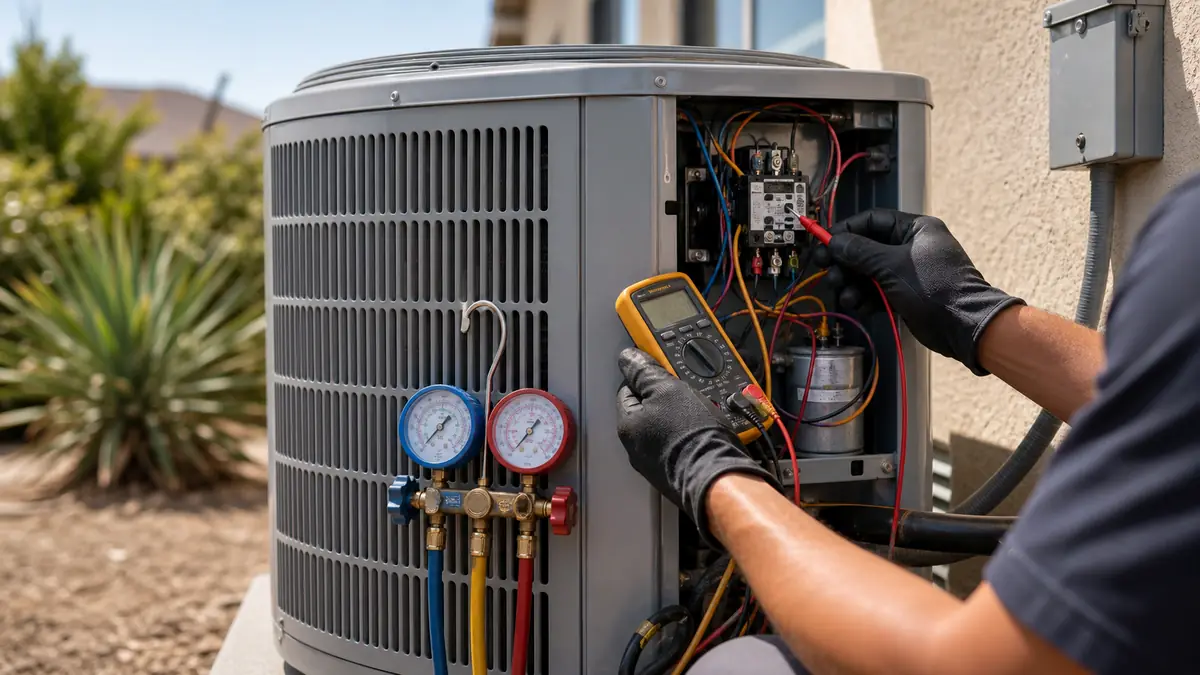
What do Mitsubishi error codes mean on a West Covina mini-split?
A Mitsubishi Electric ductless or ducted system does not throw vague "service" lights - it names the fault with a two-character code, and the first character is the map. P-codes are indoor-unit protection faults: a P5 for the drain pump, a P6 for coil freeze or overheat, a P1 or P2 for a room or pipe thermistor that has drifted. U-codes live outside on the condenser and inverter: a U4 for an outdoor thermistor, a U2 for high discharge temperature, a U6 for compressor overcurrent. E-codes are the conversation between the two units - an E6 or E7 means the indoor and outdoor boards stopped talking over the S1/S2/S3 wires. Around West Covina, where a lot of mid-century South Hills and Galaxie ranch homes had single-zone heads retrofitted into closets and side yards, the codes we read most are drain, thermistor, and communication faults - the parts that age fastest in a hot, dusty San Gabriel Valley summer.
Which Mitsubishi codes show up most in West Covina homes?
Below is a working reference for the codes our techs read most on local Mitsubishi systems, with the first thing we check and a 2026 West Covina cost lane. The two we cover in depth on their own pages are P5 and U4. Always confirm the exact code on your remote or kumo app before ordering parts - a single character is the difference between a $150 sensor and a $1,500 refrigerant job.
| Code | Meaning / first check | Cost lane |
|---|---|---|
| P5 | Drain pump abnormal / high condensate - clear the drain, test the pump and float | $79-$400 |
| U4 | Outdoor thermistor open/short - test the sensor and harness on the condenser | $150-$2,000 |
| P6 | Coil freeze / overheat protection - dirty filter or coil, or low charge | $79-$1,500 |
| P1 / P2 | Intake or pipe thermistor fault - test/replace the indoor sensor | $150-$600 |
| U2 | High discharge temperature - low charge, dirty outdoor coil, or compressor | $225-$3,500 |
| E6 / E7 | Indoor-outdoor communication - S1/S2/S3 wiring or a control board | $79-$2,000 |
How do we read codes on a Mitsubishi system?
Reading the code right is half the diagnosis, so the tech does not guess at blinks. If you have a wired MA or PAR remote, the two-character code prints on the screen and we note it directly. On a basic wall head with no wired controller, we count the operation and timer LED flash pattern against Mitsubishi's chart - a steady slow blink is often a normal mode, while a counted pattern is a real code. The kumo cloud app is the tiebreaker: it logs each fault with a timestamp, so we can see whether a code fired once on the hottest Vincent afternoon or trips every cycle. We also pull the history off the outdoor board's service connector when a U-code is involved, because the inverter records the conditions at the moment it tripped. That record tells us whether a U4 was a momentary sensor glitch or a harness that is failing under heat.
How do we fix Mitsubishi error codes once we know the cause?
Every code points at a part or a measurement, and we prove the cause before we replace anything. For a P5 drain fault we clear the condensate line, flush the pan, and bench-test the pump and float - on West Covina's hard water the float arm and pump impeller scale up and stick. For a thermistor code like P1, P2, or U4 we ohm the sensor against its resistance-versus-temperature curve and check the harness for heat damage, since a $150 sensor is the fix far more often than a board. For a P6 freeze trip we restore airflow - filter, coil, blower - and verify charge. For communication E-codes we land and torque the S1/S2/S3 terminals and check for rodent or corrosion damage on the interconnect before condemning a board. Only when sensors, charge, and wiring are proven good does an inverter or control PCB go on the quote. That order keeps a West Covina repair honest: you pay for the part that actually failed, not the most expensive guess.
West Covina Mitsubishi error-code questions
Where does a Mitsubishi mini-split show its error code?
On the indoor head and in the kumo cloud app. A wall head blinks its operation or timer LED in a pattern; a wired MA or PAR remote shows a two-character code like P5, U4, or E6 right on the screen; and the kumo app logs the same code with a timestamp. If you only see blinks, count them against the brand's flash chart, or read the code off the remote and tell us - that one detail often shortens the visit.
Are Mitsubishi P-codes and U-codes the same thing?
No, and the letter tells you where to look. P-codes are indoor-side protection faults - drain, thermistors, coil freeze, room-sensor problems on the head you can reach. U-codes are outdoor or inverter protection faults - thermistors, discharge temperature, compressor overcurrent on the condenser outside. E-codes are usually communication or address faults between the two units. Knowing the letter sends the tech to the right cabinet before the truck even rolls.
Can I clear a Mitsubishi error code by resetting power?
Sometimes, but only as a test, not a fix. Cutting power at the disconnect for a couple of minutes clears a one-time glitch, and if the code never returns it was a fluke. If the same code comes back within a cycle or two, the fault is real and the unit is protecting itself - resetting repeatedly just hides a problem that is quietly getting worse. We diagnose the cause rather than loop the reset.
Do error-code repairs cost the same across West Covina ZIPs?
Yes - our diagnostic and labor rates are flat across 91790, 91791, 91792, and 91793, from South Hills down to Vincent. What changes the bill is the part the code points at: a drain clear or a thermistor is a low-cost visit, while an inverter or control board lands in the $400 to $2,000 range. We confirm the cause before quoting, so the price matches the real fault.