Mitsubishi AC and Mini-Split Repair in West Covina
Plain answer: West Covina Mitsubishi HVAC repairs Mitsubishi Electric mini-splits and AC across West Covina, including Galaxie and Woodside Village (91790, 91792), reading the P, E, and U fault codes on the controller and crediting the $79-$200 diagnostic toward the fix, so call (213) 449-4344 or book online. We are an independent shop, not a Mitsubishi dealer.
The overview
- We repair M-Series MSZ wall heads, MFZ floor consoles, MLZ cassettes, and SVZ/MVZ ducted air handlers.
- Code-literate: P-codes (drain/sensors), E-codes (comms), U-codes (outdoor/inverter), F-codes (P-Series power).
- Diagnostic $79-$200, credited toward an approved West Covina repair.
- Capacitor/contactor $150-$450; leak repair $225-$1,500; inverter board $400-$2,000.
- Open daily 7am-9pm; same-day common when a system is fully down in heat.
- In-warranty Mitsubishi units referred to authorized service first.
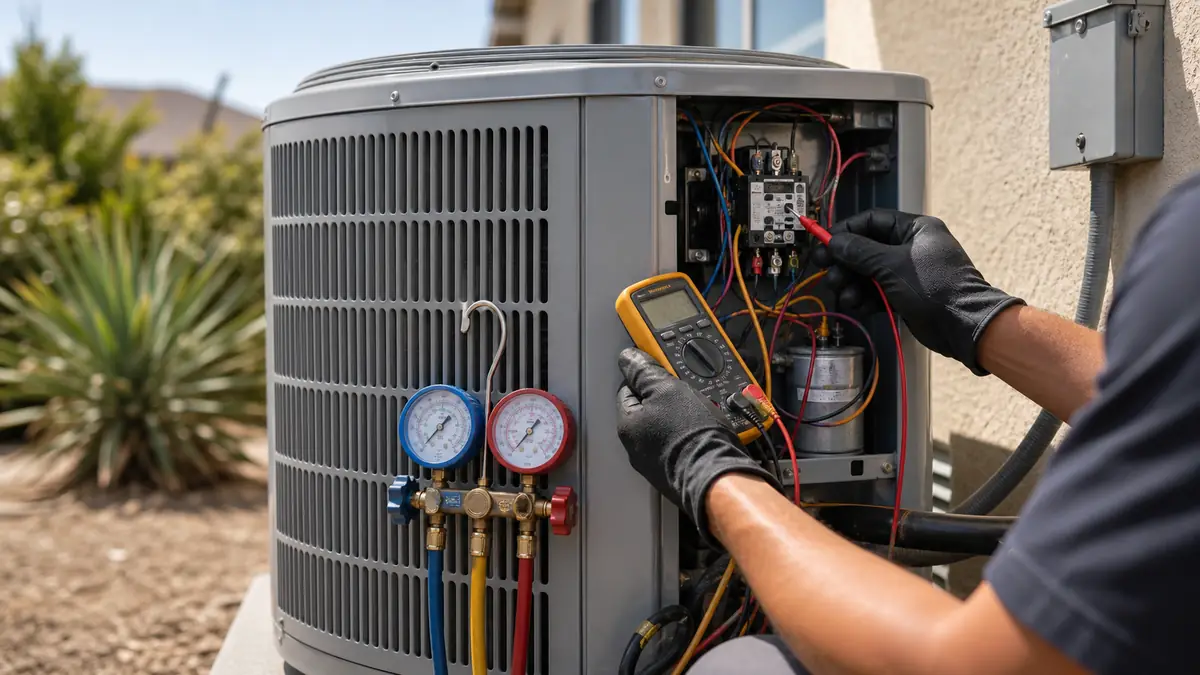
What goes wrong with Mitsubishi AC in West Covina?
In Climate Zone 9, the most common no-cool failures we see are heat-driven. Outdoor electrical parts cook over years of 90 F-plus afternoons, refrigerant slips out at flare joints, and dirty coils choke airflow until the unit protects itself. Mitsubishi reports faults through the indoor green LED blink pattern and the controller or kumo cloud code, so the first thing we do on a warm-air call is read that code rather than guess - it rules whole categories of cooling failure in or out before a panel comes off.
Reading the cooling fault code first
Pull the letter-plus-number code off the wireless remote, the MHK2 thermostat, or the kumo cloud app, and the no-cool job narrows fast:
- P6 - freeze/overheat protection, the classic dirty-filter or dirty-coil airflow restriction that strands the head on a 95 F afternoon.
- U7 - low discharge superheat, the textbook low-charge signature pointing at a leaking flare joint.
- P8 - abnormal pipe temperature, the other tell-tale of a leak, which we verify by charging the line with dry nitrogen and watching for a pressure drop.
- U6 - compressor overcurrent or inverter (IPM) fault on the MUZ board, often after a capacitor weakens.
- U1 / U2 - high-pressure or high-discharge trip in the heat of the day, usually a sun-baked, dirty condenser coil or an overcharge.
- P4 / P5 - drain sensor or drain pump, condensate backing up under the wall head, not a refrigerant problem.
- E6 / E7 / EA - inter-unit S1/S2/S3 comms, frequently a loose or corroded terminal on a retrofit splice.
How does a Mitsubishi AC repair actually go?
A repair visit runs in a fixed order so you pay for a fix, not a guess. First we read the fault at the source - the indoor green LED blink count, the wired controller, or the kumo cloud history - because a Mitsubishi tells you whether it tripped on a P6 (freeze/overheat), a U7 (low discharge superheat), or a U6 (compressor overcurrent) before we touch anything. Next we confirm the physical basics a code cannot fake: filter and indoor-coil condition, static pressure if it is a ducted SVZ/MVZ, refrigerant charge by superheat and subcooling at the service ports, and the outdoor electrical - capacitor microfarads against the nameplate, contactor contacts for pitting, and the S1/S2/S3 inter-unit terminals for tightness and corrosion. With the cause pinned, you get a written diagnosis and a fixed price before any part comes off the truck. On an approved repair the diagnostic credits toward the work, and once the part is in we re-check superheat, amp draw, and supply-air temperature so the head actually holds setpoint on a 95 F afternoon - not just clears the code.
Which Mitsubishi AC models does this cover?
The repair approach spans the whole M-Series and the residential P-Series, with small differences per line. MSZ wall heads - the value MSZ-WR09NA, the mid-tier MSZ-HM, and the deluxe MSZ-FS09NA/FS12NA with the 3D i-see occupancy sensor - are the most common West Covina single-zone heads; the newest MSZ-FX06NL H2i plus shows up on premium retrofits. Outdoors, MUZ single-zone condensers (MUZ-WR, MUZ-FS09NA, MUZ-FS18NA2) and MXZ / MXZ-SM multi-zone units carry the inverter compressor and PCB. MFZ-KJ floor consoles and MLZ cassettes share the indoor faults but differ at the drain and blower. Ducted SEZ, SVZ, and MVZ air handlers add an ECM blower motor and static-pressure checks, and P-Series PUZ/PEAD/PVA systems on larger homes use the F-code family for power and phase. We match the part to your exact model tag, because an inverter PCB for an MXZ-SM is not the board for a single-zone MUZ.
What does each symptom usually cost to repair?
This is the table we quote against for West Covina. Cost lanes are 2026 SoCal approximations confirmed on your actual equipment - a clean charge and the right part beats a parts-cannon every time.
| Symptom / code | Likely cause / first check | Cost lane |
|---|---|---|
| Warm air, short run times; P6 | Dirty filter/coil or low airflow tripping freeze protection | $79-$300 |
| Ice on coil, weak cooling; U7 / P8 | Low charge from a leaking flare joint; LEV/EEV sticking | $225-$1,500 |
| Outdoor unit hums or is dead; U6 / U9 | Run capacitor, then inverter PCB / IPM; voltage check | $150-$3,500 |
| Water under wall head; P4 / P5 | Clogged condensate drain or failed drain pump | $79-$450 |
| Random shutdowns; E6 / E7 / EA | Loose or corroded S1/S2/S3 inter-unit wiring; control board | $150-$2,000 |
| High-pressure trip in heat of day; U1 / U2 | Dirty condenser coil, overcharge, or U4 outdoor thermistor | $150-$900 |
| Airflow not following the room; (sensor) | 3D i-see sensor or P1/P2/P9 thermistor drift (MSZ-FS) | $150-$700 |
What does AC repair cost in West Covina, and why?
The total breaks into a few moving parts. The diagnostic ($79-$200, often near $139 in the San Gabriel Valley) buys the code read and the charge/electrical workup, and it credits toward an approved repair. From there the part decides the lane: a run/start capacitor or contactor on a Galaxie MUZ condenser is mostly trip and labor at $150-$450, while a refrigerant leak repair runs $225-$1,500 because the cost driver is finding and re-flaring the leaking joint and recharging R-410A at roughly $50-$80 per pound installed. A Mitsubishi inverter PCB is $400-$2,000 - the board itself is often $120-$800-plus - and a DC inverter compressor is the high end at $1,200-$3,500, which is exactly where the repair-versus-replace math gets serious. Two things move your number within a lane: how easy the outdoor unit is to reach (a hillside South Hills condenser is more setup than a side-yard Merlinda unit) and whether the fault damaged a second component, like a leak that also starved the compressor.
Which Mitsubishi components fail most here?
On the outdoor side, the run/start capacitor is the single most common SoCal AC failure - cheap part, mostly labor and trip. Next is the DC inverter compressor and the inverter PCB on units that have lived through a decade of inland heat. Indoors, the condensate drain pump and the TH1/TH2/TH5 thermistors drift or fail, and on premium MSZ-FS heads the 3D i-see occupancy sensor can act up. The LEV/EEV electronic expansion valve sticking is a quieter cause of weak cooling that a code read plus a superheat check will catch.
Should I repair this unit or start over?
Here is the short test we hand West Covina homeowners on the spot. Stack the repair price against a brand-new system: once the fix crosses the 50 percent mark of that replacement number and your unit has been baking through inland summers for 10 to 12 years or more, the repair stops paying off. A second sanity check multiplies the age of the unit by the dollar figure on the repair - clear roughly $5,000 on that product and replacement is the smarter spend. None of this happens behind your back; we talk the numbers through before you sign off. If you are sitting on the fence, the West Covina buying guide and the AC installation page lay out the replacement side.
What is different about AC repair in West Covina specifically?
Climate Zone 9 in the eastern San Gabriel Valley drives the failure pattern. Sustained inland heat - 55 to 75 days a year at or above 90 F, July highs around 92-96 F - cooks outdoor capacitors and bakes condenser coils, so the run-capacitor and dirty-coil calls cluster in the worst stretches of July and August. The post-war Galaxie, Merlinda, and Vincent tract homes often have the outdoor unit in a tight side yard with afternoon sun and little airflow, which raises head pressure and triggers U1 high-pressure trips that a shaded, cleaned coil would avoid. Up in South Hills, multi-zone MXZ-SM systems on larger estates fail differently - usually a single zone's head or a comms fault on one branch rather than the whole condenser. Knowing the neighborhood tells us what to suspect before we open the panel.
What if my Mitsubishi unit is still under warranty?
Be honest with yourself about the install date. Mitsubishi Electric backs the compressor and parts for a set period when a system was installed and registered through their channel. If you are inside that window, your cheapest path is a Mitsubishi Electric authorized contractor, because they can process the warranty claim. Once you are out of warranty - which most West Covina repair calls are - an independent shop like ours is the better value, and we will tell you which side you are on before you spend a dollar.
West Covina AC repair questions
My MSZ wall head blinks but blows warm in the West Covina heat - what is first?
We check the simple, common culprits first: a dirty filter or coil cutting airflow (a frequent P6 freeze-protection trigger), then refrigerant charge and the flare joints, then the outdoor capacitor and inverter board. On a 95 F West Covina afternoon a low charge or restricted coil shows up fast as warm air and short run times.
Is a Mitsubishi inverter board really worth replacing on an older unit?
Sometimes. A Mitsubishi inverter PCB runs roughly $400 to $2,000 installed. On a 12-year-old MXZ multi-zone we will run the repair-versus-replace math with you before ordering; on a 6-year-old single-zone MUZ it is usually a clear repair, especially if it is the only fault.
How much does AC repair usually cost in West Covina?
It opens with a $79 to $200 diagnostic (often near $139) that credits toward the work. Common repairs land like this: capacitor or contactor $150 to $450, refrigerant leak repair and recharge $225 to $1,500, inverter or control board $400 to $2,000. You see the price before we touch a part.
Do you carry common Mitsubishi parts on the truck?
We stock high-failure consumables - capacitors, contactors, drain pumps, thermistors, and common filters. Inverter PCBs and DC inverter compressors are ordered to your exact model number (the MSZ/MUZ/MXZ tag), so those usually take a return visit once the part lands.
Can you fix just one head on my South Hills multi-zone system?
Yes. On an MXZ or MXZ-SM multi-zone setup, one head can fault or lose comms while the others run fine - often a P5 drain issue, a thermistor, or a loose S1/S2/S3 branch connection. We diagnose the affected zone without disturbing the rest, and only involve the shared outdoor unit if the code points there.
How fast can you get to a no-cool call in West Covina during a heat wave?
We are open daily 7am to 9pm and keep same-day slots for fully-down systems during West Covina heat events. A single-head problem that still leaves part of the house cool can usually wait a day or two for a scheduled visit, which often gets you a better window. Call and we will tell you honestly where you land.