Mitsubishi P5 Code in West Covina, CA - The Drain Pump Fault
Plain answer: A Mitsubishi P5 code in West Covina, CA (ZIPs 91790 to 91793) means the indoor drain pump is abnormal or the condensate level has tripped the float - usually a clogged drain line, a tired pump, or a stuck sensor in our hard-water homes; call (213) 449-4344 or book online and we clear it.
The overview
- P5 = drain pump abnormal or high condensate level - an indoor-side protection fault.
- Components in play: condensate pan, drain pump, float sensor, and the drain line itself.
- Switch the head off when P5 shows; the pan is near overflow and can wet a ceiling.
- Drain clear within a $79-$200 visit; a replacement drain pump roughly $150-$400.
- Hard water and a long inland summer drive scale and biofilm that cause repeat P5s.
- Independent shop; in-warranty units go to authorized service first.
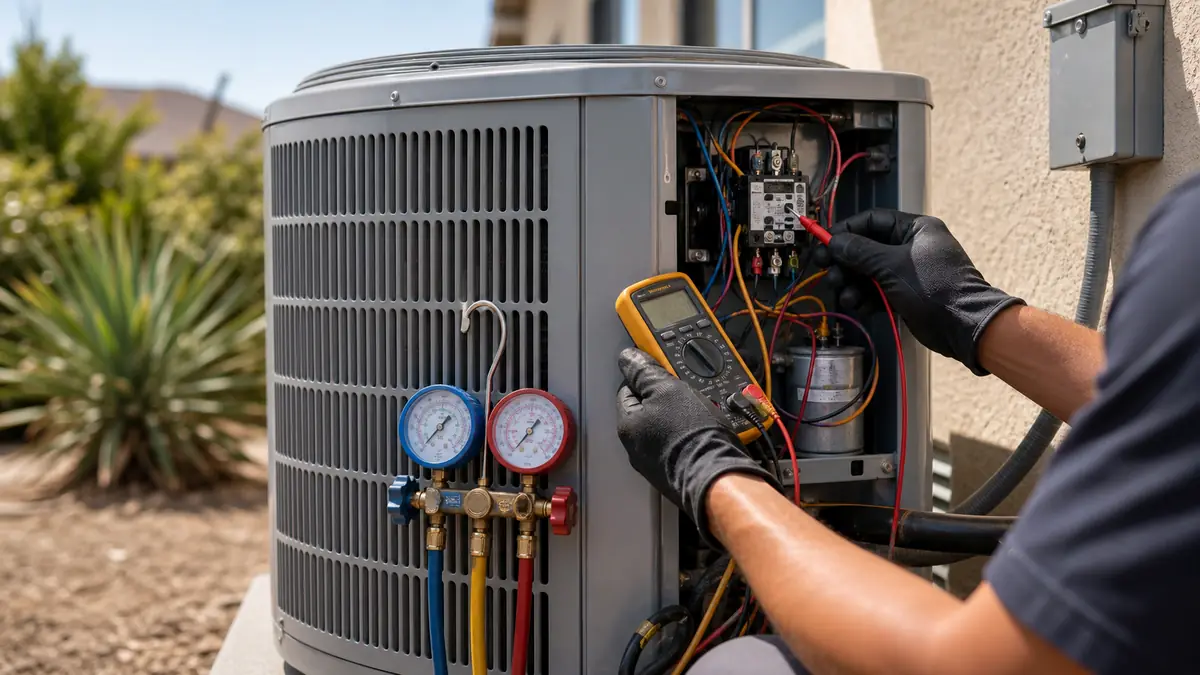
What does the P5 code mean on a Mitsubishi unit?
P5 is the head telling you it has water it cannot get rid of. Every indoor Mitsubishi unit that sits above its drain - wall-mounted heads, ceiling cassettes, and concealed-duct air handlers - relies on a small condensate pump and a float switch to lift the water the air conditioner pulls out of your air and push it to a drain. When the float rises past its safe level, or the control sees the pump running without the water going down, it logs P5 and stops cooling on purpose. That shutdown is a feature: it trades a warm room for a dry ceiling. The fault almost never lives in the refrigerant circuit, so chasing pressures or the compressor on a P5 is a wasted afternoon - the answer is in the pan, the pump, the float, or the drain line leaving the unit.
Why does a Mitsubishi throw P5 in West Covina homes?
The eastern San Gabriel Valley climate and West Covina's housing stock conspire on this one. Summers here run hot and long against the Inland Empire edge, so the system condenses water for months, and a warm, wet pan grows biofilm - the slime that narrows a drain and fouls a float. The local water is hard, so scale builds on the float arm and the pump impeller until one sticks. And a lot of the mid-century ranch and minimal-traditional homes in South Hills, Merlinda, and Vincent had ductless heads added years after they were built, with condensate lines run on whatever slope the installer could manage through an existing wall - a flat run or a missing trap lets water sit and back up. Newer Spanish-style hillside homes are not immune either; a cassette in a high ceiling has the longest, most punishing lift for its little pump. Put those together and P5 is one of the most common codes we read on local Mitsubishi gear.
How do you diagnose a P5 drain fault step by step?
The walkthrough is deliberately mechanical, because P5 is a plumbing problem in an electronic costume. Step one: confirm the code on the remote or kumo app and power the head down so the pan is not climbing while we work. Step two: open the unit and look - a pan brimming with water and a dry pump tell a different story than a dry pan with a chattering pump. Step three: test the drain line by pouring a measured cup of water into the pan and watching whether it leaves; a slow or no-drain confirms a clog or a bad slope. Step four: pull and bench the condensate pump - we power it on the bench and watch for flow, and on West Covina's hard water we check the impeller for scale lockup. Step five: ohm and free the float switch, since a sticking float reads "high" even on an empty pan. Step six: vacuum the line, flush it, and verify a full pan empties in seconds before we call it solved. Each step is a look or a measurement, so the quote names the part that actually failed - line, pump, or float.
What can I safely check before calling a pro?
There is real homeowner ground here, and it is all on the outside of the refrigerant system, so it is safe. Turn the head off first. Find where the condensate line exits - often a small white pipe at the wall or a tube into a Vincent or Galaxie side-yard drain - and check the end for slime, dirt, or a wasp nest blocking it. If you have a wet/dry vacuum, gently pull suction on the open end of the drain to clear a soft clog; that alone clears many P5s. Wipe any standing water you can safely reach in the pan. What you should not do: open the sealed refrigerant side, jumper or bypass the float switch, or run the unit with P5 active to "dry it out" - that defeats the very safety that is protecting your ceiling. If the code returns after you clear the visible line, the pump or float is the cause, and that is our call. Our AC repair page covers what the visit looks like, and the Mitsubishi error-code hub maps the neighboring codes.
When is a P5 code urgent?
Treat any active P5 as time-sensitive, because the failure mode is water in your home. The float tripped at a near-full pan, so the margin before an overflow is small - on a wall head mounted high in a Woodside Village living room, an overflow stains drywall and can short the indoor board. It is most urgent if you see water at the bottom of the head, hear the pump cycling without the pan emptying, or the same code returns within minutes of a reset. It is less urgent, but still worth a same-week visit, if a single P5 cleared after you flushed the line and has not come back - that points to a one-time soft clog. Either way, do not keep resetting it; each reset just refills the pan. We run same-week service across all four West Covina ZIPs, so a P5 does not have to sit.
West Covina Mitsubishi P5 questions
What does a P5 code mean on my Mitsubishi mini-split?
P5 means the drain pump is abnormal or the condensate float has tripped on a high water level. The indoor head senses water it cannot pump out fast enough and shuts down cooling to keep your West Covina ceiling and drywall dry. It is a protection code, not a refrigerant or compressor fault, so the fix is usually on the drain side - a clogged line, a failed pump, or a stuck float.
Can I keep running the unit with a P5 showing?
No, and that is the one code where running it anyway risks real damage. The float tripped because water is at or near the rim of the pan; force the system on and the next stop is an overflow onto a Galaxie or Woodside Village ceiling. Switch the head off, leave it off, and clear the cause. A P5 on a wall-mounted head with a built-in pump is especially unforgiving because the pan sits high in the room.
How much does a Mitsubishi P5 repair cost in West Covina?
A simple drain clear falls inside a $79 to $200 visit. If the pump itself has failed, a replacement drain pump runs roughly $150 to $400 installed. A stuck float sensor sits between those. We confirm which it is on site - we do not swap a pump if a five-minute drain flush restores it - so you pay for the actual fault, not a guess.
Why does my West Covina home keep throwing P5 codes?
Repeat P5 codes almost always trace to the drain path, not the pump. West Covina's hard water leaves scale that narrows the line and gums the float, biofilm grows in a warm pan over a long inland summer, and a drain run with too little slope or a missing trap lets water back up. Fixing the underlying drain - reslope, clear, add a trap or float safety - stops the repeat far better than replacing parts one at a time.